
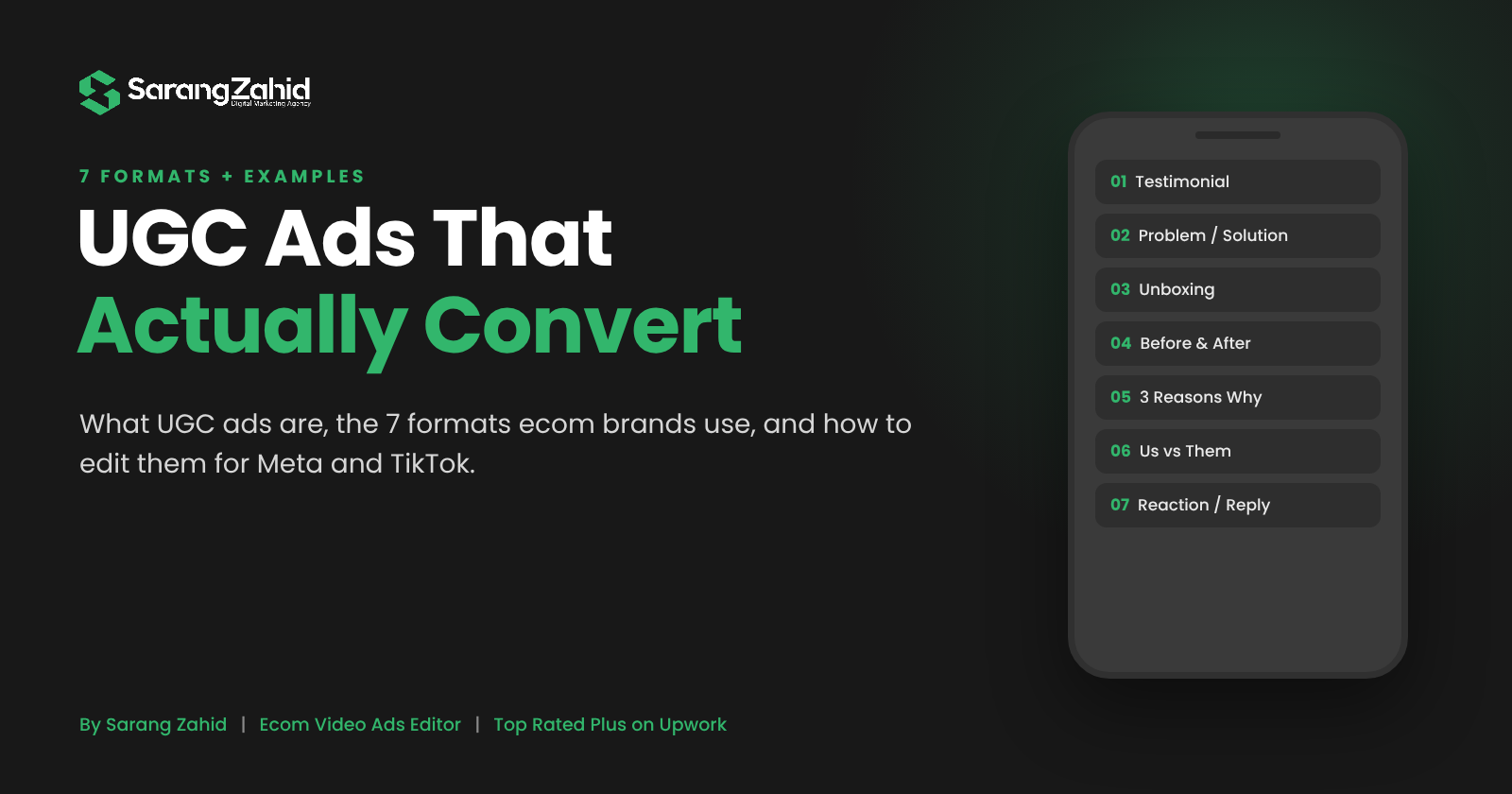
UGC ads are paid social ads that look like real customers made them: a person talking to camera, unboxing, testing or reviewing a product on their phone. They work because people trust people more than polished brand ads, and because they look native in Reels and TikTok feeds. The 7 formats that convert best for ecom are the testimonial, problem/solution, unboxing, before and after, “3 reasons why”, comparison, and street-style or reaction videos. Every strong UGC ad follows the same structure: hook, problem, product, proof, CTA.
Scroll through Reels for one minute and count the ads. Most of the ones that stop you are not glossy brand videos. They are a person holding a product, talking to their phone like they are telling a friend about it.
That is a UGC ad. And for most ecom and DTC brands, it has become the default ad format on Meta and TikTok.
I edit UGC ads every week for brands and agencies. In this guide I will explain what UGC ads are, why they work, the 7 formats I see convert most often, and how to plan and edit them so they actually sell.
What Are UGC Ads?
UGC stands for user-generated content. In advertising, a UGC ad is a paid ad made in the style of content a regular customer would post: filmed on a phone, spoken in first person, and focused on a real experience with the product.
Today most UGC ads are not made by random customers. Brands hire UGC creators, people who specialize in filming natural-looking product videos, and then run that footage as ads. Some brands also use real customer videos (with permission) or AI UGC, which uses AI avatars or voices. I compare the two in UGC vs AI UGC ads.
UGC Ads vs Influencer Ads vs Brand Ads
| UGC ad | Influencer ad | Brand ad | |
| Who appears | A creator or customer | A known creator with an audience | Brand talent or product only |
| Where it runs | Your ad account | The creator’s page, or yours via partnership ads | Your ad account |
| What you pay for | The content | Reach and the content | Production |
| Look | Phone-shot, native | Native, creator’s style | Polished |
| Best for | Testing many angles at low cost | Borrowing trust from an audience | Brand awareness |
Why UGC Ads Work
- People trust people. In Bazaarvoice’s 2024 Shopper Experience Index, 65% of shoppers said they rely on UGC such as reviews, photos and videos when deciding what to buy (Bazaarvoice).
- They look native. A phone video blends into Reels and TikTok. Viewers do not skip it as quickly as an obvious ad. TikTok’s own guidance recommends featuring creators and using a less polished, native look (TikTok creative best practices).
- Creator content performs on TikTok. TikTok reports that Spark Ads built on creator content saw a 43% higher conversion rate and a 30% higher completion rate than standard in-feed ads in its 2020 to 2021 study data (TikTok Creative Center).
- They are cheap to test. One creator shoot can give you 5 to 10 ads once you edit different hooks, lengths and formats from it.
The 7 UGC Ad Formats That Convert
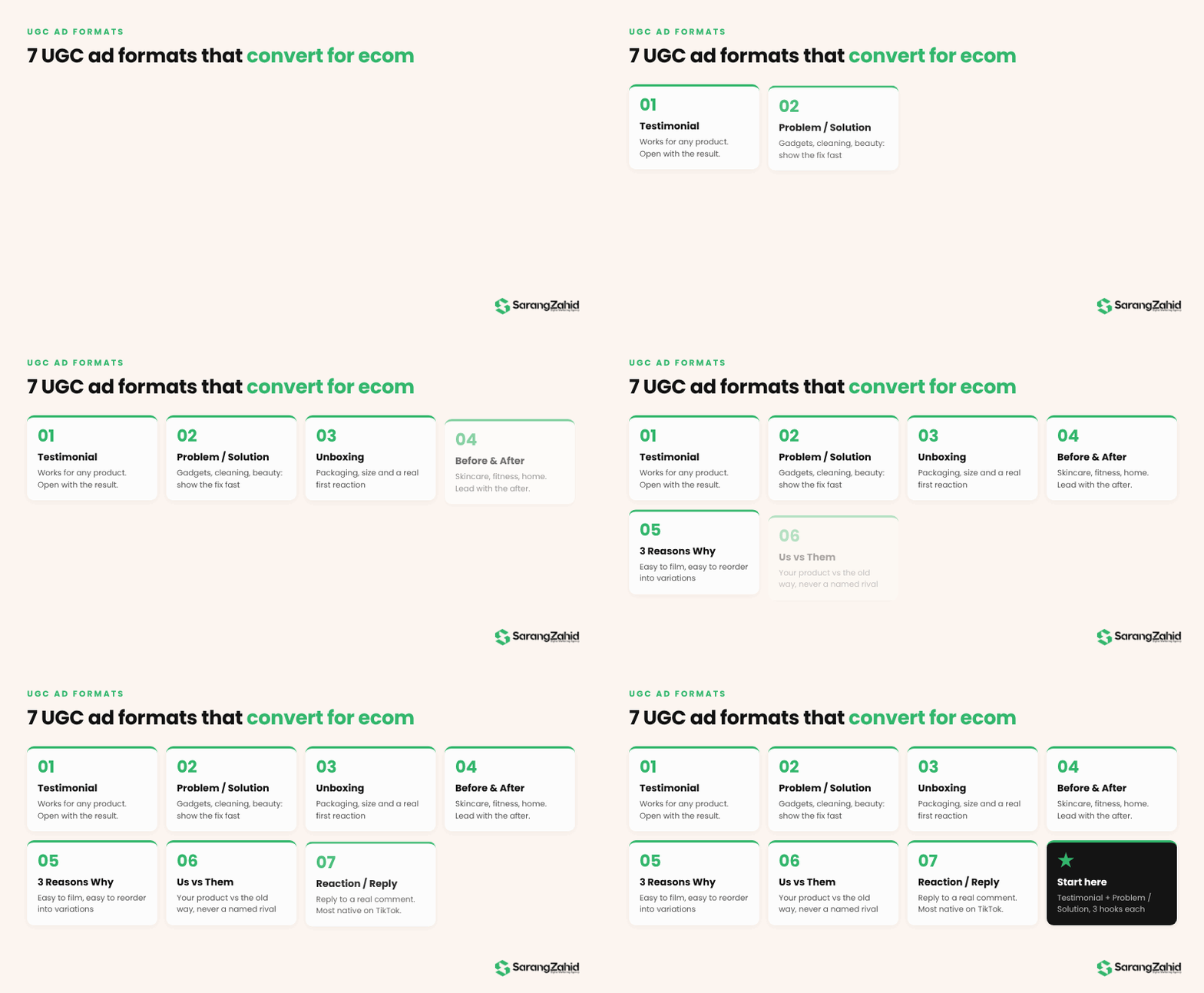
1. The Testimonial
A customer or creator tells their story with the product: what life was like before, what changed, what they would tell a friend. It works for almost every product and is the best place to start if you are new to UGC.
Edit tip: open with the result, not the backstory. “I have not had a breakout in 6 weeks” beats “So I have always had bad skin”.
2. Problem / Solution
The creator shows a frustrating problem, then the product solving it on camera. Strong for gadgets, cleaning products, beauty and anything with a visible effect.
Edit tip: keep the problem short (3 to 5 seconds). Viewers already know the problem; they want the fix.
3. Unboxing and First Impressions
The creator opens the package and reacts. It shows the product, packaging and size honestly, which answers questions buyers have before checking out.
Edit tip: cut the slow parts of opening the box and keep the genuine reaction.
4. Before and After
A split screen or quick cut from before to after. Very strong for skincare, fitness, home and cleaning products. Check platform rules on before and after claims in health and beauty.
Edit tip: show the after first as the hook, then rewind to the before.
5. “3 Reasons Why”
The creator lists three reasons they love the product, with on-screen numbers. Easy to film, easy to watch, and easy to make into variations by changing the order of the reasons.
Edit tip: put the strongest reason first, not last.
6. Comparison or Us vs Them
The creator compares the product with the usual alternative: the old method, a cheaper option, or “what I used before”. Good for products with a clear advantage.
Edit tip: never name a competitor brand. Show the generic alternative.
7. Street Style, Reaction and Green Screen
Quick interview-style clips, reacting to comments, or the creator talking over a screenshot of reviews. These feel the most native to TikTok and Reels.
Edit tip: reply-to-comment videos work well as hooks. Use a real comment from your page.
The Structure Behind Every Good UGC Ad

Whatever the format, the ads that sell follow the same order:
- Hook (0 to 3 seconds). A line, visual or text that stops the scroll. See my 15 video ad hooks that stop the scroll.
- Problem (3 to 8 seconds). Name the pain your buyer feels.
- Product (8 to 15 seconds). Show it in use, close up, early and more than once.
- Proof (15 to 22 seconds). Results, reviews, ratings, before and after.
- CTA (last 3 seconds). Tell people exactly what to do, with the offer.
For a 15-second version, merge problem and product. For 60 seconds, add more proof, not more problem.
How to Make UGC Ads Step by Step
- Pick 2 or 3 angles. For example, saves time, replaces something expensive, and gift idea.
- Write a short brief for the creator. Key message, must-say points, things to avoid, and 3 hook lines to film. My guide on how to brief a video editor covers the editing side.
- Ask for more footage than you need. Multiple takes of each hook, B-roll of the product, and raw reactions.
- Edit for sound-off viewing. Captions on every line, on-screen text for the key message, product visible within the first few seconds.
- Cut variations. 3 or more hooks, 15s and 30s lengths, 9:16 and 4:5 formats.
- Test and scale. Launch in a testing campaign, read hook rate and CPA, and scale the winners. I explain the full setup in Meta ad creative testing.
UGC Ad Mistakes That Waste Budget
- Making it too polished. Heavy color grading and studio lighting make UGC look like an ad again.
- Slow intros. “Hi guys, so today I want to talk about…” loses most viewers in the first second.
- Product shown too late. If the product appears at second 12, many people never see it.
- One hook only. One ad, one hook, one test. Cut at least three.
- No captions. Many people watch with the sound off.
- Fake-looking claims. Scripted lines that no real person would say break the trust that makes UGC work.
- No usage rights. Make sure your creator contract allows paid ad usage and for how long.
Have creator footage sitting in a folder? I turn raw UGC into testimonial, unboxing and problem/solution ads with 3+ hooks per shoot. See my UGC video ad editing service or get a free hook teardown of your best ad.
Key Takeaways
- UGC ads are paid ads that look and feel like real customer content, usually filmed by hired UGC creators.
- They work because they borrow trust and look native in Reels and TikTok.
- Start with testimonials and problem/solution ads, then expand into the other 5 formats.
- Every good UGC ad follows hook, problem, product, proof, CTA.
- One shoot should give you many ads: edit several hooks, lengths and ratios from it.
Final Thoughts
UGC ads are not a trend that will pass. They are simply what ads look like on platforms built around people talking to their phones. The brands that win with them are not the ones with the most expensive creators; they are the ones that brief clearly, edit sharply and test many angles. Start with one product, two angles and three hooks, and build from there.
FAQs About UGC Ads
What does UGC mean in ads?
UGC means user-generated content. A UGC ad is a paid ad that looks like content a real customer would make, usually a phone video in first person.
Are UGC ads better than regular ads?
For direct-response on Meta and TikTok, UGC ads often beat polished brand ads because they feel native and trustworthy. Polished ads still have a place for brand awareness and retargeting. Test both.
How much do UGC ads cost?
Creator fees vary a lot by market and experience, from under $100 to several hundred dollars per video, plus editing. Editing several hooks and lengths from one shoot lowers the cost per ad.
How long should a UGC ad be?
Most perform best between 15 and 30 seconds. Test a 60-second version for higher-priced products that need more explanation.
Can I use customer videos as ads?
Yes, with written permission that covers paid advertising. Reviews with video are excellent raw material for testimonial ads.
Do I need a UGC creator to make UGC ads?
No, but it helps. You can use customer videos, team members, or AI UGC for early tests, then hire creators to re-shoot the winning angles.
[AUTHOR BOX: same as other posts] About the Author: Sarang Zahid is an ecom and DTC video ads editor with 5+ years of experience. He is Top Rated Plus on Upwork (Top 5% of talent) and edits UGC, AI UGC and VSL ads for brands on Meta and TikTok. Work with Sarang.
Sources: Bazaarvoice Shopper Experience Index Vol. 18 (Nov 2024), TikTok creative best practices, TikTok Creative Center: Return on Influence.