

You have about one second to stop the thumb. Not five. Not three. One. Whatever happens in that first moment decides whether the rest of your ad (the demo, the offer, the CTA you spent hours on) ever gets seen.
I’ve edited ads for ecom and DTC brands across 238+ projects on Upwork, and the hook is the single part I test the most. Change the first line or first visual of a “dead” ad and it can come back to life. In this guide you’ll get 15 proven video ad hooks with examples you can copy, when to use each one, how to edit them for Meta and TikTok, and how to tell which hook is actually working.
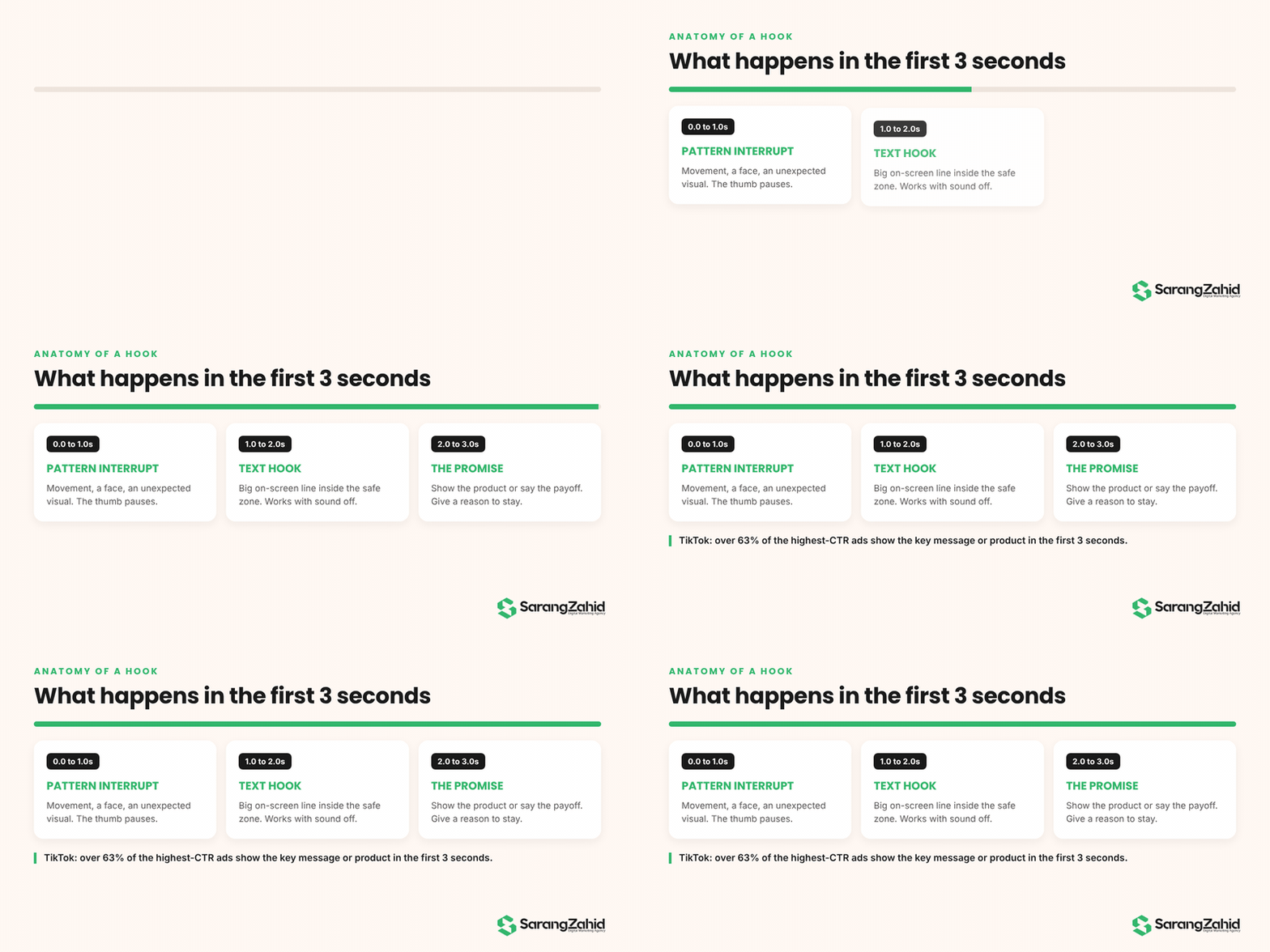
| The short answer: A video ad hook is the first 1 to 3 seconds of an ad, designed to stop the scroll and make the viewer want to keep watching. The best hooks combine a visual pattern interrupt, a bold on-screen text line and a clear promise, and they show the key message or product early. TikTok found that over 63% of its highest-CTR ads do exactly that within the first 3 seconds. The fastest way to improve an ad is to test 3 to 5 different hooks on the same body. |

What Is a Video Ad Hook?
A hook is the opening of your ad: the first visual, the first words and the first on-screen text. Its only job is to earn the next few seconds. It’s not the place to explain your product, show your logo or say hello.
A strong hook usually has three layers working together:
- Visual: movement, a face, a surprising shot, or the product in action
- Text: a short, bold line on screen, because many people watch with sound off
- Audio: the first spoken line, or a sound that grabs attention
Why the First 3 Seconds Decide Your Ad’s Performance
The platforms have shared clear data on this:
- TikTok: over 63% of the videos with the highest click-through rate show their key message or product within the first 3 seconds.
- TikTok: its creative best practices advise introducing your core proposition in the first 3 seconds and placing the hook within the first 6.
- Meta: research reported by Search Engine Land found that opening with an audio-visual hook is linked to 1.5x higher purchase intent for direct-response Reels ads.
The 15 Video Ad Hooks
I group hooks into five families: curiosity, problem, proof, native and offer. Every hook below has an example, when to use it and an editing tip.

1. The Secret or Hack Hook (Curiosity)
Example: “This trick can lower blood pressure fast.” (an angle I edited for Daily Beats, a beetroot juice brand)
Best for: health, wellness, food and any product with a surprising benefit.
Edit tip: Pair the line with a close-up of the product or ingredient in the first frame. For health products, keep claims compliant with platform policies and what the brand can actually back up.
2. The “Nobody Talks About This” Hook (Curiosity)
Example: “Nobody talks about this skincare step, and it’s why your moisturizer isn’t working.”
Best for: products that solve a hidden or overlooked problem.
Edit tip: Start mid-sentence with the creator leaning in. It feels like you walked into a conversation.
3. The “Wait For It” Hook (Curiosity)
Example: “Watch what happens when I pour this on a stain…”
Best for: visual products with a satisfying result: cleaning, beauty, kitchen, gadgets.
Edit tip: Show the “before” right away and tease the result with a quick flash cut. Don’t make them wait more than a few seconds.
4. The Pain Call-Out Hook (Problem)
Example: “If your hair gets greasy by day two, this is for you.”
Best for: almost every ecom product. It filters in the exact buyer.
Edit tip: Use “you” in the on-screen text and show the problem visually, not just verbally.
5. The “Stop Doing This” Hook (Problem)
Example: “Stop buying expensive protein bars until you see this.”
Best for: challenging a habit or a competitor category.
Edit tip: A quick hand gesture or “stop” motion in the first frame adds a physical pattern interrupt.
6. The Mistake Hook (Problem)
Example: “3 mistakes you’re making with your morning coffee.”
Best for: educational angles and products that fix a common error.
Edit tip: Number each mistake on screen. Numbers promise structure and keep people watching to the end.
7. The Results-First Hook (Proof)
Example: “I lost the bloating in 7 days. Here’s the only thing I changed.”
Best for: products with visible or felt results. Only use real, honest results.
Edit tip: Open on the result shot, then cut back to the story. End first, then explain.
8. The Before and After Hook (Proof)
Example: A split screen of a dull countertop next to a shiny one, with the text “Same counter. 30 seconds apart.”
Best for: cleaning, beauty, home, fitness and organization products.
Edit tip: Split screen or a fast wipe transition works best. Keep the text to five words or fewer.
9. The “I Tried It for X Days” Hook (Proof)
Example: “I used this posture corrector every day for 30 days. Honest review.”
Best for: UGC testimonials and products where consistency matters.
Edit tip: Add a small day counter in the corner (“Day 1” to “Day 30”) to create a mini story arc.
10. The POV Hook (Native)
Example: “POV: you finally found a water bottle that keeps ice for 24 hours.”
Best for: TikTok and Reels, lifestyle products and Gen Z or millennial audiences.
Edit tip: Shoot or edit it first-person and use trending caption styling so it looks like organic content, not an ad.
11. The Reply-to-Comment Hook (Native)
Example: A comment bubble on screen reading “Does this actually work on curly hair?” followed by the creator answering.
Best for: handling objections and building social proof.
Edit tip: Recreate the platform’s comment-reply sticker style. It instantly reads as native.
12. The Talk-to-Camera Hook (Native)
Example: “Okay, I need to tell you about the best thing I bought this month.”
Best for: UGC creators and AI avatars alike.
Edit tip: TikTok reports that one in three auction ads with the highest view-through rate break the fourth wall by talking directly to the viewer. Frame the face close and start speaking on frame one.
13. The Price or Deal Hook (Offer)
Example: “This is why everyone’s buying this $19 hoodie.”
Best for: sales, launches, bundles and impulse-buy price points.
Edit tip: Make the price the biggest text on screen. Animate it in with a pop.
14. The Us vs Them Hook (Offer)
Example: “$80 serum vs our $24 serum. Can you tell the difference?”
Best for: challenger brands and products with a clear advantage.
Edit tip: Side-by-side comparison with clear labels. Let the visual do the arguing.
15. The Gift Hook (Offer)
Example: “The gift she’ll actually use (not another candle).”
Best for: seasonal campaigns, BFCM, holidays and gifting categories.
Edit tip: Open on an unboxing or reaction shot. Seasonal text and emojis help it feel timely.
Hook Cheat Sheet: Which Hook to Use When
| Your goal | Best hook families | Example hooks |
|---|---|---|
| Cold audiences who don’t know you | Curiosity, Problem | Secret or hack, Pain call-out |
| Prove the product works | Proof | Before and after, Results-first |
| Look native on TikTok and Reels | Native | POV, Reply-to-comment |
| Push a sale or launch | Offer | Price or deal, Gift |
| Beat a competitor | Problem, Offer | Stop doing this, Us vs them |
| Handle objections | Native, Proof | Reply-to-comment, I tried it for X days |
How to Edit a Hook That Works
The words are only half the hook. Here’s what I do in the edit:
- Start on motion. Never open on a still frame or a logo.
- Put text on screen in frame one, inside the safe zone so platform buttons don’t cover it.
- Show the product early. TikTok’s data on its highest-CTR ads supports this.
- Cut fast. The first 3 seconds should often have 2 to 3 cuts.
- Use sound with intent. TikTok notes that tracks above 120 BPM often drive higher view-through rates.
- Match the hook to the body. If the hook promises a result, the ad must deliver it, or viewers bounce.
For the complete editing process from raw footage to export, see my video ad editing guide for ecom brands.
How to Test Hooks (and Measure Hook Rate)
The best hook is the one your data picks, not the one you like most.
What Is Hook Rate?
Hook rate is the share of people who watched at least the first 3 seconds of your ad. On Meta, a common way to calculate it is 3-second video plays divided by impressions. It tells you if the opening is doing its job, separately from whether the rest of the ad converts.
| Metric | What it tells you | If it’s low, fix this |
|---|---|---|
| Hook rate (3-second plays / impressions) | Is the opening stopping the scroll? | The hook: first visual, text, first line |
| Hold rate (ThruPlays / 3-second plays) | Does the ad keep attention? | Pacing, problem and proof section |
| CTR | Does the ad make people want to act? | Offer, CTA, message clarity |
| CPA or ROAS | Does it make money? | Offer, landing page, audience fit |
A Simple Hook Testing Method
- Keep the body the same. Only change the first 3 seconds.
- Make 3 to 5 hooks from different families (for example, one curiosity, one problem, one proof).
- Launch them together in the same campaign so they get a fair test.
- Compare hook rate first, then CTR and CPA.
- Iterate on the winner. Make 3 to 5 new versions of the winning hook style.
This is also where AI UGC shines: you can test many hooks cheaply before paying a creator to re-shoot the winner. I explain that system in UGC vs AI UGC ads.
5 Hook Mistakes to Avoid
- Opening with your logo or brand name. Branding can come early, but not as the very first frame.
- Clickbait that the ad doesn’t pay off. You’ll get views but no sales, and it can hurt trust.
- Too much text. Keep the on-screen hook to roughly 5 to 10 words.
- Slow “Hey guys” intros. Start mid-action or mid-sentence.
- Testing only one hook. One hook is a guess. Five hooks is a test.
| Want 5 to 10 new hooks for your best ad? I turn winning ads into hook and angle variations for ecom and DTC brands on Meta and TikTok. See my projects or get a free hook teardown of your best ad. |
Key Takeaways
- The hook is the first 1 to 3 seconds, and it decides whether the rest of the ad is seen.
- Show the key message or product early. TikTok found 63%+ of top-CTR ads do this in the first 3 seconds.
- Use all three layers: visual, text and audio.
- Rotate across the five families: curiosity, problem, proof, native and offer.
- Test hooks on the same body and judge them by hook rate first.
- Iterate on winners every week.
Final Thoughts
Your product, your offer and your landing page only matter if people stop scrolling. Hooks are the cheapest and fastest lever in your entire ad account: one new opening on an existing ad can outperform a brand-new shoot. Save this list, pick three hooks from different families, and test them on your best ad this week.
FAQs About Video Ad Hooks
How long should a video ad hook be?
Aim for 1 to 3 seconds. TikTok recommends introducing your core message in the first 3 seconds and placing the hook within the first 6, but the sooner you grab attention, the better.
What is a good hook rate for Facebook ads?
It varies by niche, offer and placement, so the most useful benchmark is your own account. Track hook rate (3-second plays divided by impressions) across your ads and keep testing new hooks against your current best.
What is the difference between a hook and a headline?
The hook is the opening of the video itself: the first visual, words and on-screen text. The headline is the text field in the ad unit, usually shown below the video. Both matter, but the hook does the work of stopping the scroll.
How many hooks should I test per ad?
Test 3 to 5 hooks per ad body to start, ideally from different hook families. Once you find a winner, make 3 to 5 new variations of that style.
Do hooks work the same on TikTok and Meta?
The principles are the same, but TikTok rewards more native, creator-style hooks like POV and reply-to-comment, while Meta’s feed also responds well to strong benefit, result and offer hooks. Test on each platform.
Can AI help me create ad hooks?
Yes. AI tools can help you write hook ideas and produce AI UGC versions to test quickly. The best results still come from testing real data and refining the winning hooks in the edit.
| About the Author
Sarang Zahid is an ecom and DTC video ads editor and social media content creator with 5+ years of experience. He is Top Rated Plus on Upwork (Top 5% of talent) with 238+ projects and 13,000+ hours, and edits UGC, AI UGC and VSL ads for brands on Meta and TikTok. He was named Employee of the Year 2025 at Logicade. Work with Sarang. |