
THE SHORT ANSWER (short-answer box): To test Meta ad creatives in 2026, run a separate testing campaign where each new concept gets its own ad set and equal budget, use broad targeting, and give each creative enough spend to read (roughly 1,000+ impressions and a few days). Judge ads on hook rate, hold rate, CTR and CPA together, not CPA alone. Move winners into your main scaling campaign, then edit new hooks off the winners every week. Test different concepts, not tiny tweaks, because Meta groups look-alike ads together.

Most brands do not have a targeting problem on Meta anymore. They have a testing problem.
They launch five versions of the same ad with different headlines, wait three days, look at ROAS, turn everything off and decide “video doesn’t work for us”. Meanwhile the one ad with a great hook never got enough budget to prove itself.
I edit Meta ad videos for ecom and DTC brands and work closely with the media buyers who run them. In this guide I will show you a simple creative testing framework that works with how Meta delivers ads today: how to set up the test, how many ads to run, which numbers to read, and when to kill or scale.
What Is Meta Ad Creative Testing?
Creative testing is the process of launching new ads in a controlled way so you can see which concepts, hooks and formats bring the best results, then putting more budget behind the winners.
It is not the same as a classic A/B test. An A/B test changes one variable and needs a lot of data to be statistically sure. Creative testing for most brands is faster and more practical: you launch several distinct ideas, read early signals, and keep a steady pipeline of new ads coming.
Why Creative Testing Matters More After Andromeda
Meta’s ad delivery system, known as Andromeda, now uses the creative itself to decide who sees an ad. Detailed targeting matters less. Your ad’s visuals, words and format tell Meta which people to show it to.
That changes two things:
- Creative is your targeting. A testimonial from a busy mom and a gym-bro POV video will find different buyers, even with the same broad audience.
- Similar ads count as one. Ads that look almost the same can be grouped together, so ten headline swaps on one template are not ten tests. Meta now encourages “creative diversification”: different formats, styles and angles. Jon Loomer notes that Meta’s old guidance of no more than six ads per ad set has disappeared, and advertisers report success with many more.
Creative also wears out faster. Many media buyers now plan to refresh winning ads every 2 to 3 weeks instead of every 6 or more (TheOptimizer).
How to Set Up a Creative Testing Campaign
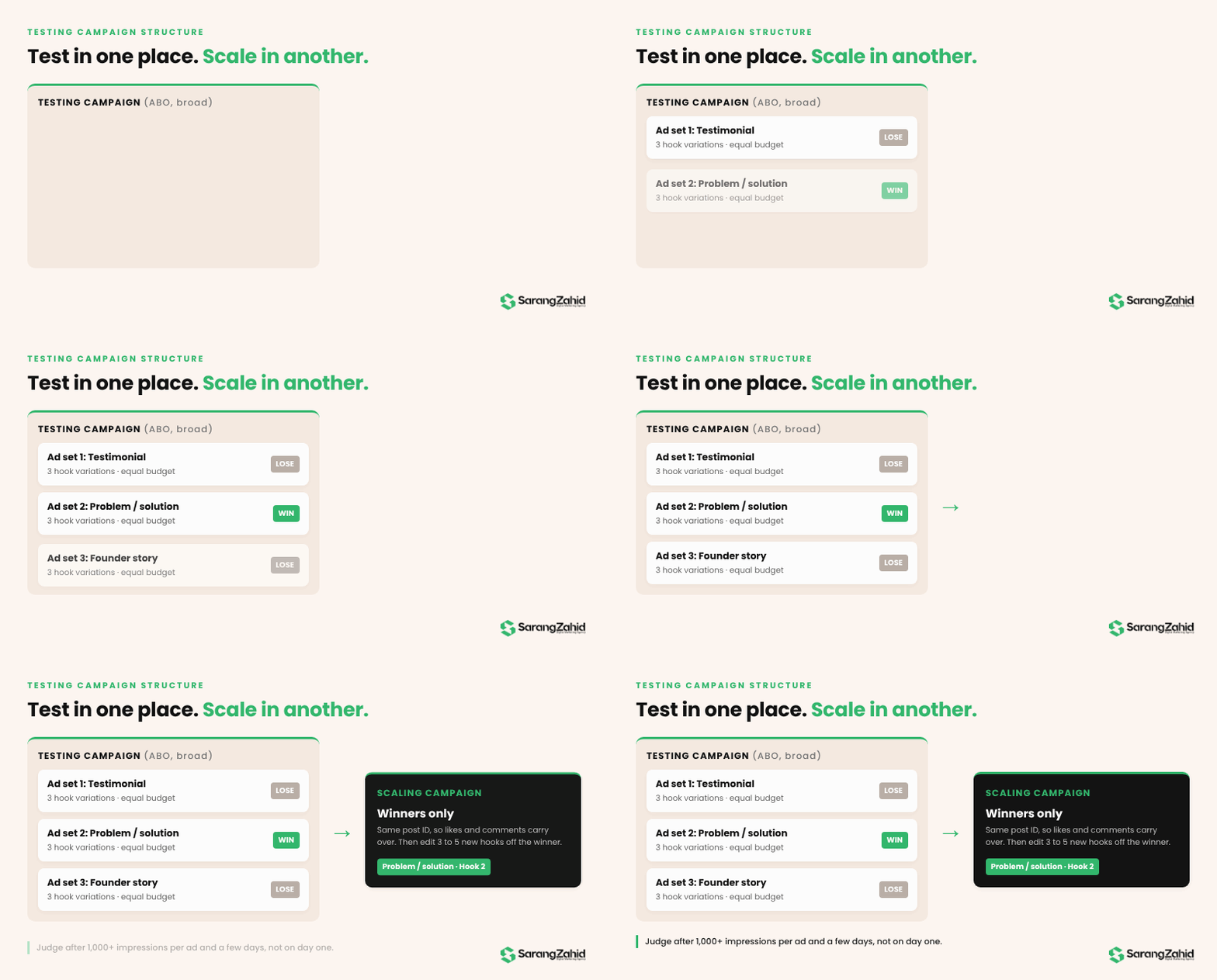
Keep testing and scaling apart so new ads do not have to fight your proven winners for budget.
Step 1: Create a Dedicated Testing Campaign
Use the same optimization event as your main campaign (usually purchases). Set budgets at the ad set level (ABO) so each concept gets a fair share. Keep targeting broad.
Step 2: One Concept per Ad Set
Put one concept in each ad set, with 2 to 4 hook variations inside it. A concept is a different idea, for example a founder story, a customer testimonial, a problem/solution demo or a comparison. Hook variations change only the first 3 seconds.
Step 3: Give Each Ad Set an Equal Budget
A common rule from media buyers is $20 to $50 a day per ad set, depending on your product price and CPA. Higher-priced products need more spend to get enough purchases to read.
Step 4: Let It Run Long Enough
Meta says an ad set leaves the learning phase after about 50 optimization events in 7 days (summary by JetFuel). You do not need 50 purchases per creative to judge it, but you do need a few days and at least 1,000 impressions per ad before reading anything. Avoid big budget changes during the test, as they can reset learning.
Step 5: Move Winners to Scaling
When an ad beats your benchmarks, duplicate it into your main campaign using the same post ID, so likes and comments carry over. Keep the original running in testing until the new copy has data.
How Many Creatives Should You Test?
It depends on spend. A practical starting point many teams use:
| Monthly ad spend | New concepts per month | Active ads at once |
| Under $5,000 | 4 to 8 | 6 to 12 |
| $5,000 to $15,000 | 8 to 12 | 15 to 25 |
| $15,000 to $50,000 | 15 to 25 | 25 to 50 |
| $50,000+ | 25 to 40+ | 50+ |
The rows from $5,000 a month and up follow the volumes suggested by TheOptimizer. Expect most tests to lose. A hit rate of 1 in 10 is normal, which is exactly why volume matters.
What to Test (in This Order)
Test big changes first. Small tweaks only matter once you have a winning concept.
- Concept and angle. What the ad is about: pain, desire, proof, comparison, offer.
- UGC talking head, product demo, founder video, static, carousel, AI UGC.
- The first 3 seconds: opening line, first visual, on-screen text. See my 15 video ad hooks for ideas.
- Creator or talent. The same script with a different person can change results a lot.
- Length and pacing. 15s vs 30s vs 60s.
- CTA and offer framing. Percentage off vs dollar off, bundle vs single.
The Metrics That Matter
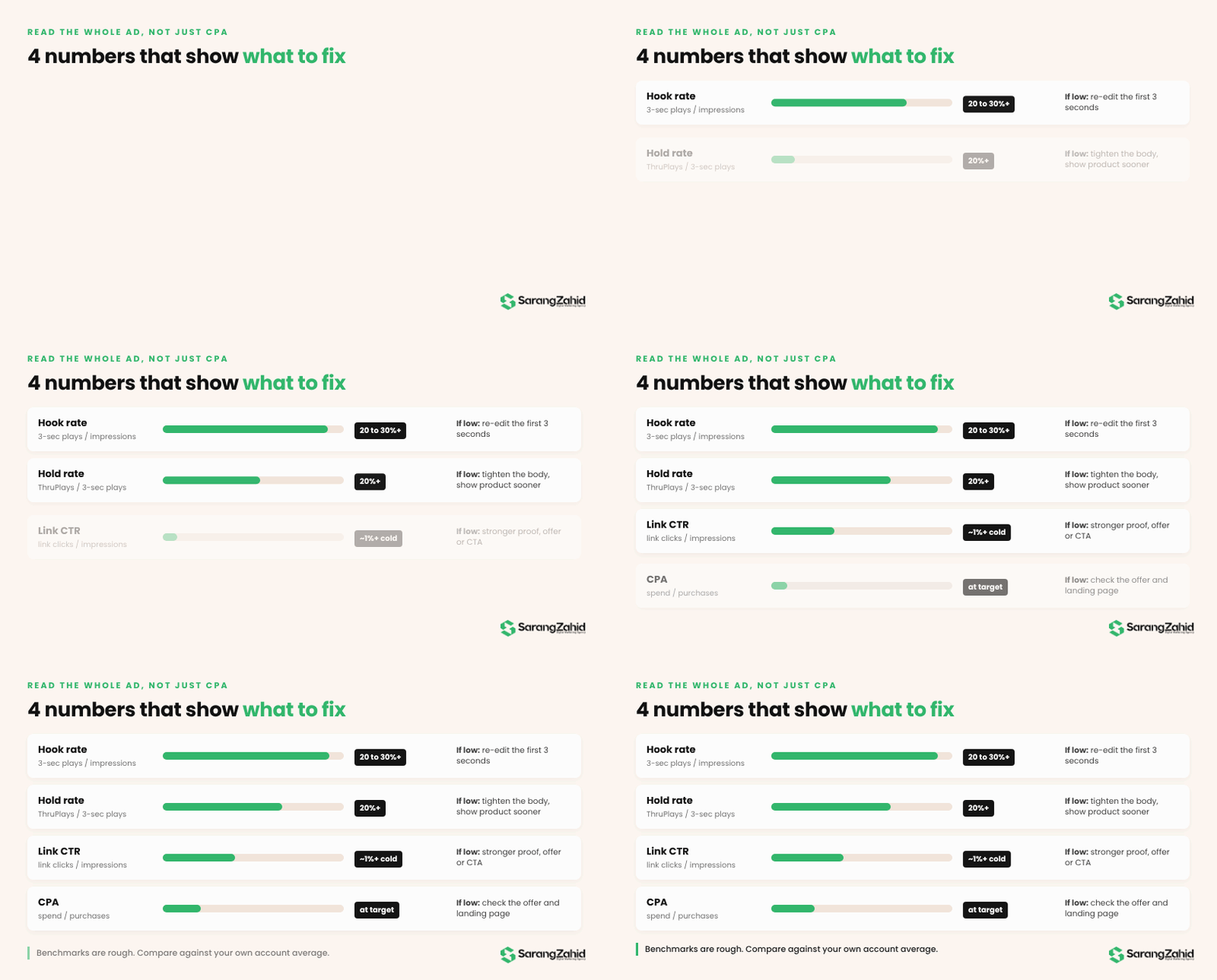
CPA is the final score, but it arrives late and is noisy at small spend. These earlier metrics tell you why an ad is winning or losing.
| Metric | How to calculate | What it tells you | Rough benchmark |
| Hook rate | 3-second video plays / impressions | Did the opening stop the scroll? | 20% to 30%+ |
| Hold rate | ThruPlays / 3-second video plays | Did the body keep people watching? | 20%+ |
| CTR (link) | Link clicks / impressions | Did the ad make people want to act? | Around 1% or above for cold traffic |
| CPA | Spend / purchases | Did it make money? | Your break-even target |
Hook rate and hold rate benchmarks follow TheOptimizer’s 2026 playbook; CTR varies by niche, so compare against your own account average. Add hook rate and hold rate as custom metrics in Ads Manager so you see them next to CPA.
How to Read the Numbers Together
- Low hook rate: the first 3 seconds are the problem. Keep the body, re-edit the hook.
- Good hook rate, low hold rate: people stopped but left. Tighten the body, show the product sooner.
- Good hold rate, low CTR: they watched but were not convinced. Strengthen proof, offer or CTA.
- Good CTR, high CPA: the ad works, the landing page or offer might not. Check the page before blaming the creative.
When to Kill, Keep or Scale an Ad
- Kill early if an ad has spent about one target CPA with no purchases and a weak hook rate.
- Keep watching if hook and hold rates are strong but purchases are still low, especially for higher-priced products. Give it up to 7 to 14 days.
- Scale when CPA is at or below target and the early metrics are healthy. Move it to the scaling campaign and order 3 to 5 new hook variations of it right away.
Turning One Winner Into Ten New Tests
The fastest way to new winners is to edit off the ones you already have. When an ad wins, keep the body and change:
- the hook line and first visual (3 to 5 new hooks)
- the creator, using the same script
- the format: a 9:16 Reel version, a 4:5 Feed version and a static from the best frame
- the length: a 15-second cut of a 30-second winner
This is most of the work I do for agencies. It is cheaper than shooting new content and it keeps the account fresh. I cover the editing side in my guide to video ad editing for ecom brands.
6 Creative Testing Mistakes to Avoid
- Testing tiny changes. Headline swaps on the same video are not separate tests anymore.
- Judging on day one. Early CPA swings a lot. Wait for enough impressions.
- Mixing tests with scaling. New ads lose to proven ads in the same ad set because Meta favors what already has data.
- Looking only at ROAS. Without hook and hold rate you do not know what to fix.
- Editing ads mid-test. Changing the creative resets learning. Launch a new ad instead.
- No pipeline. If new creatives are not ready when the winner fatigues, performance drops for weeks.
Need a steady flow of new hooks and variations to test? I edit Meta ad videos built for creative testing, with every file named and sized for its placement. See my projects or get a free hook teardown of your best ad.
Key Takeaways
- Keep a separate testing campaign with one concept per ad set and equal budgets.
- Test different concepts and formats first. Meta groups look-alike ads together.
- Read hook rate, hold rate and CTR alongside CPA to know what to fix.
- Plan for most tests to lose and keep 1 to 2 weeks of new creative ready.
- Scale winners, then immediately edit new hooks off them.
Final Thoughts
Creative testing is not about finding one perfect ad. It is about building a system that finds a new winner every few weeks. Set up the structure once, read the right numbers, and keep a steady flow of fresh concepts coming. That is what keeps CPA stable as you scale.
If you need the creative side handled, see my Meta ad videos and ad creatives services.
FAQs About Meta Ad Creative Testing
How many ads should I put in one Meta ad set?
Meta no longer publishes a hard recommendation. For testing, 2 to 4 hook variations of one concept per ad set keeps results easy to read. Scaling campaigns can hold many more ads.
How long should a creative test run?
At least 3 to 7 days and around 1,000+ impressions per ad before judging. Higher-priced products may need up to 14 days.
What is a good hook rate for Meta ads?
Around 20% to 30% is a common target for cold traffic, but compare against your own account. A rising hook rate on a new edit is the clearest sign the opening works.
Should I use ABO or CBO for creative testing?
ABO (ad set budgets) is the most common choice for testing, because each concept gets an equal share. CBO or Advantage+ campaigns work well for scaling proven ads.
How often should I refresh ad creatives?
Watch for rising CPA and falling hook rate on the same ad. Many brands now plan new creative every 2 to 3 weeks for their top ads.
Is it better to test static ads or video ads?
Test both. Statics are fast and cheap to produce, videos usually explain the product better. Running both formats also helps Meta find different audiences.
About the Author: Sarang Zahid is an ecom and DTC video ads editor with 5+ years of experience. He is Top Rated Plus on Upwork (Top 5% of talent) and edits UGC, AI UGC and VSL ads for brands on Meta and TikTok. Work with Sarang.
Sources: Jon Loomer: How many ads is too many?, TheOptimizer: How to test ad creatives on Meta after Andromeda, JetFuel: Meta ads learning phase.